I got home one evening, opened WeChat, and found that Joe had sent me an article from the tech account APPSO, “AI Is Creating an Era of Too Many Apps”. It was about the latest a16z newsletter: So Many Apps, So Little Time.
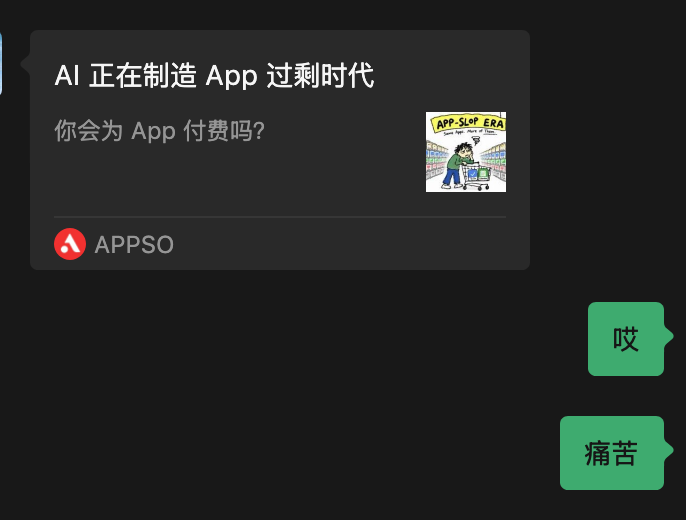
The article quoted a screenshot of a search for “vibe coding” on Xiaohongshu. The results were all posts like this one:
Why does every vibe-coded product end up as a diary, a budget tracker, a habit tracker or a note app?
For all my talk about starting a company and building things on my own, when I looked at what I had actually made, I couldn’t escape the diaries, the budget trackers and the note apps either.
When it comes down to it, isn’t HYPATIA just a note-taking app?
The a16z report points out that while the number of new apps has multiplied, the revenue software actually earns has barely moved. Most software has almost no users.
It isn’t that the pie stayed the same and the winners took it all. No new winners appeared in the first place.
01How HYPATIA began
HYPATIA started, in a way, by accident.
At the end of August this year, I joined a good friend’s research project.
Its data and code were a mess. I wondered whether I could build something to keep track of the different versions of the data and code, and I casually vibe-coded a small product.
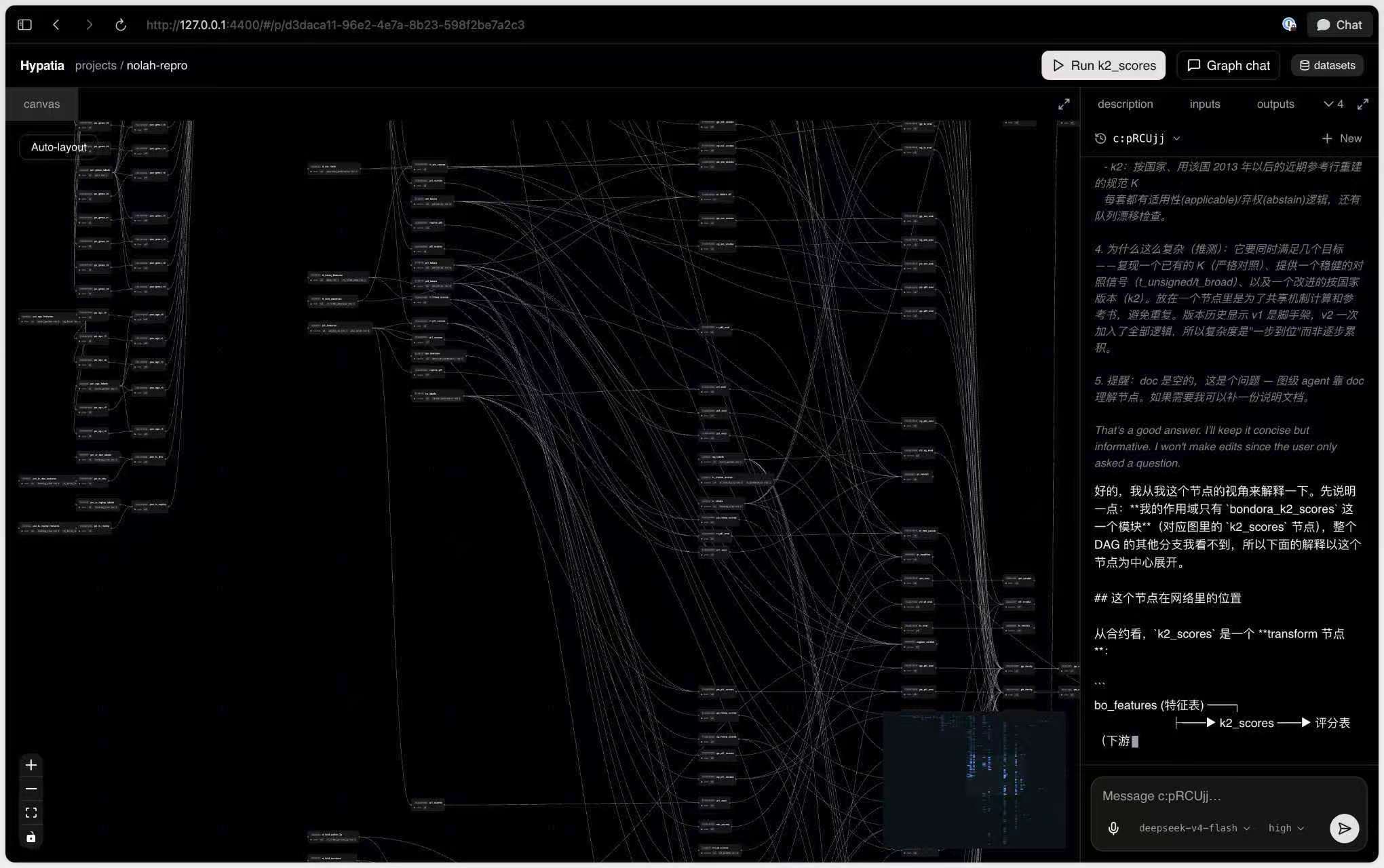
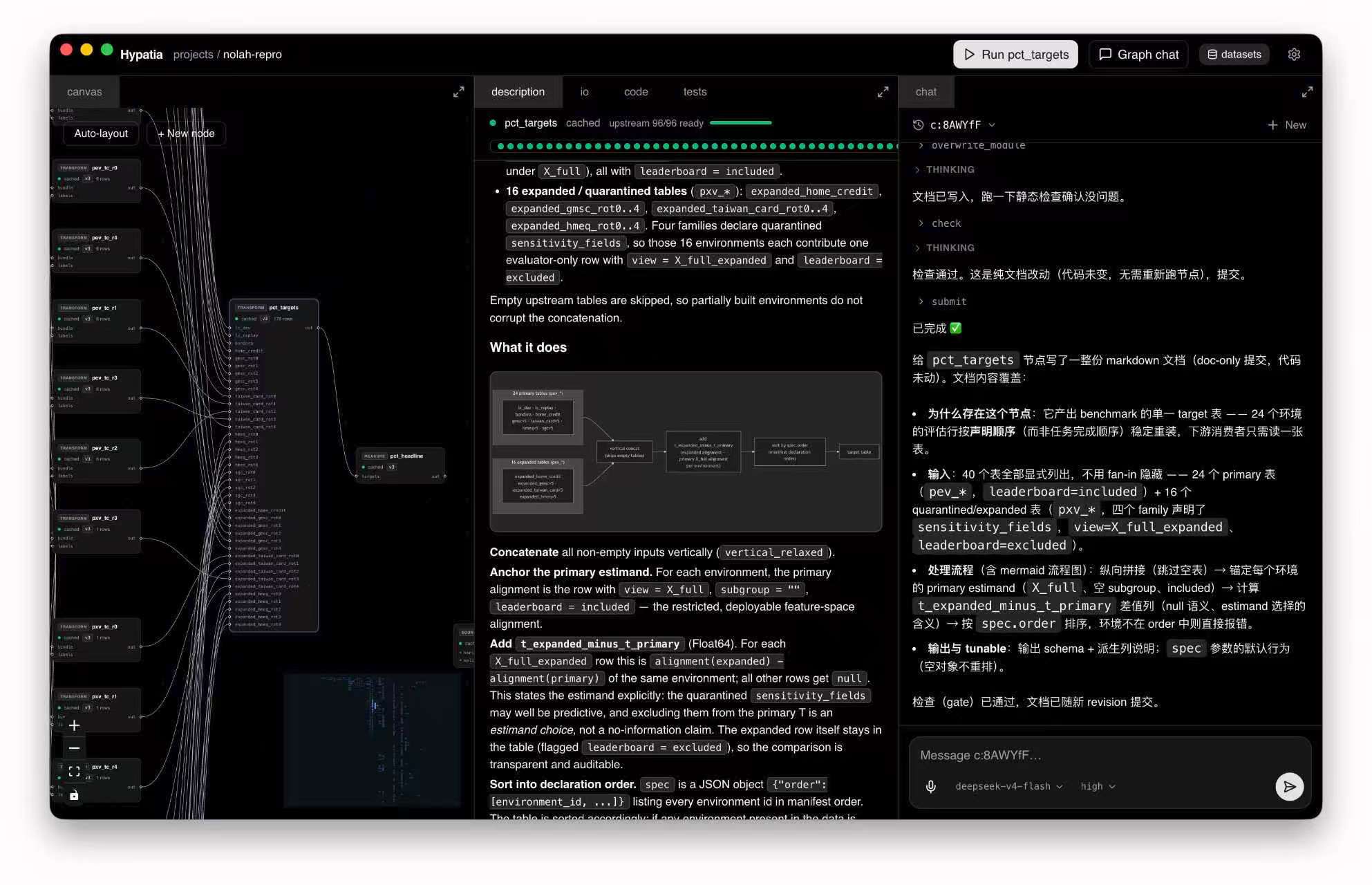
When I’d finished, my friend said it would be great if it could read papers too.
So I started building a reader.
As I went on, I realised the version-tracking part was far too immature, and not much use anyway.
The reader, though, might be useful to many more people. And it was something I had always loved and knew fairly well.
In high school I campaigned hard to go paperless. My teachers were easygoing enough to let me bring a tablet to school to take notes and study. My favourite pastime was browsing the App Store for every productivity app I could find.
Before university I worked at MarginNote for a while, in customer support and marketing. That’s where I met Joe.
Maybe a note-taking app was something I could make.
Once I actually started, what shocked me was this: a piece of software like this would once have taken me months. Now it seemed to take days.
Not full-time days, either. Days of sending off a few prompts and then heading to work.
I started to feel a little excited. So many things I couldn’t do before suddenly seemed possible.
Before this, I had already abandoned too many projects after less than two weeks. So this time I made myself one rule: whatever happens, keep going.
Don’t think about the market, don’t think about the prospects, don’t think about whether what I’m doing means anything.
Keep going.
02A programmer, lost
Let me go back to February. I went home on leave for the Spring Festival.
I’d only been home a couple of days when Joe messaged me. He’d built a product and asked whether I wanted to see it.
We got on a Tencent Meeting call and Joe showed me his video indexing tool. I’ve done some video editing, and I know how painful managing footage is. Joe’s software made managing local footage easy.
I asked how long it had taken him. Joe said, “A day.”
Only a few days earlier, I had been reflecting at work that I shouldn’t let AI take over my code wholesale, and that I should go back to writing it the old-fashioned way. Now I began to wonder whether I’d been using AI wrong, whether I’d been too careful.
So, in the phrasing of a Silicon Valley startup story I had marinated in for years, I told myself:
I’m going to rip out the brakes and floor it with AI.
Before going home I had put together a set of skills for writing slide decks at the office, and I thought they worked pretty well. Why not turn them into an app for making slides?
After splurging on two Claude Max subscriptions and burning through more than $200 of OpenRouter credit, I had built an AI pipeline that could generate all sorts of flowcharts.
It was, of course, a pile of crap, and nothing like what I had set out to make.
But I saw something frightening: I could build a project without looking at the code at all.
What frightened me wasn’t only that what I knew was suddenly worth nothing.
It was that I didn’t know what was essential any more.
If it isn’t writing code, then what? Ideas? Judgement? Taste? And what are those?
I couldn’t say.
What made me even more anxious was my half-baked grasp of economics: when ten times as many people can do something, the skill stops being worth much.
Will computer science today become what civil engineering is now?
For those few months, I couldn’t stop.
For a long stretch I kept two or three Claude subscriptions. At the peak I was running six Claude Max accounts. I spent more on AI than on rent.
At the office I earned a nickname: “the Token Emperor”.
Outside work I built an app that rolled dice to decide where to go for lunch, and an app to help me study for the CFA.
Each got less than two weeks of work. And, of course, neither was ever finished.
I was busy, but I didn’t know what I was busy with. Whenever I went home, my parents saw me hunched over a laptop with a knotted brow. When they asked what I was working on, I never had an answer.
I felt like I had done everything, and yet I had done nothing.
I remember walking out of the office door, drifting along and thinking hazily about life. Everyone dies, and life is short. What could I actually make?
03Learning to live
Around that time I noticed I kept retreating into the kitchen.
The last time that happened was at university in Sweden. The polar nights were cold and gloomy, and the food was even more hopeless. One supervisor treated me to potatoes, because they were traditional food. Another treated me to the saltiest fish I have ever eaten, also traditional food. After that, the words gave me PTSD. So I started cooking for myself. When I missed home, I made dough and wrapped dumplings.
Ever since, cooking has been a comfort. The future is so uncertain, but the kitchen is certain. Once I knew my way around it, I found it both free and dependable: a little more or less seasoning rarely ruins a dish, but give it enough heat and time and the food will always cook through.
I thought cooking was useful. It helped with my anxiety.
A friend told me she thought I should find a hobby. I pushed back: I didn’t need one, playing made me anxious, the future was too uncertain. She ignored me and insisted on singing, and introduced a whole group of our friends to a singing teacher. I went once. It was fun, and I discovered that my main problem, of all things, was a lack of rhythm. Still, I couldn’t be bothered to go back.
Maybe her words did something, though. I had bought a Switch when I started working but barely played it, and whenever I did I felt guilty. During a stretch of too much work, “I need a hobby” suddenly echoed in my head. Before I knew it I had opened Zelda, and I played for two weeks.
After two weeks I stopped, without even finishing it. It was fun, of course. I just felt I already understood why it was fun, and why so many people love it.
Another friend who loves to play kept dragging me to a Go club. I turned him down several times and eventually went.
I can’t play Go. On the way out I got talking with another beginner who had come along. We both thought the game was interesting, but neither of us could see why you would spend time practising and studying it. You would never beat the AI in the end anyway.
Later I asked the friend who had taken me. He said, “Because you get to beat other people.”
What a simple answer.
Not long ago I had dinner with a friend I’ve known for years but rarely see. After a while he suddenly said, “Everything you do, it’s like you’re calculating the return on investment.”
I was a little surprised. I had never seen myself that way. I always thought I was neither calculating nor materialistic.
But it hit home.
I cooked to ease my anxiety. I played Zelda to work out why it was fun, and stopped once I had. With Go, the first thing I asked was why learn it if I would never beat the AI.
Even finding a hobby was something I did because someone told me I needed one.
Later I went back to the Go club a few more times.
I started trying to accept that I simply like to play, and I simply like living.
Strangely, once I relaxed, the product seemed to go more smoothly too.
While building HYPATIA I set myself a rule: write prompts only in the short stretch after I get up in the morning, and hand the work to AI. The evenings are for cooking, reading and having fun.
I break that rule all the time. But in trying to keep it, I slowly came to see that no problem has to be solved tonight. I also began to see how persistence could be possible: if I can fix one problem a day, I can fix 365 in a year.
Working flat out without end, I might create ten problems a day.
And then give up within two weeks.
04An ordinary evening
Back to where I started: I closed WeChat, sat down at my computer, and researched Evernote in HYPATIA. I’ve started a series looking closely at how personal knowledge management software has developed over the past twenty-odd years, and I wanted to begin with Evernote. But Evernote isn’t software I know well, and I didn’t know the story behind it. So I asked HYPATIA to search for material, and started reading.
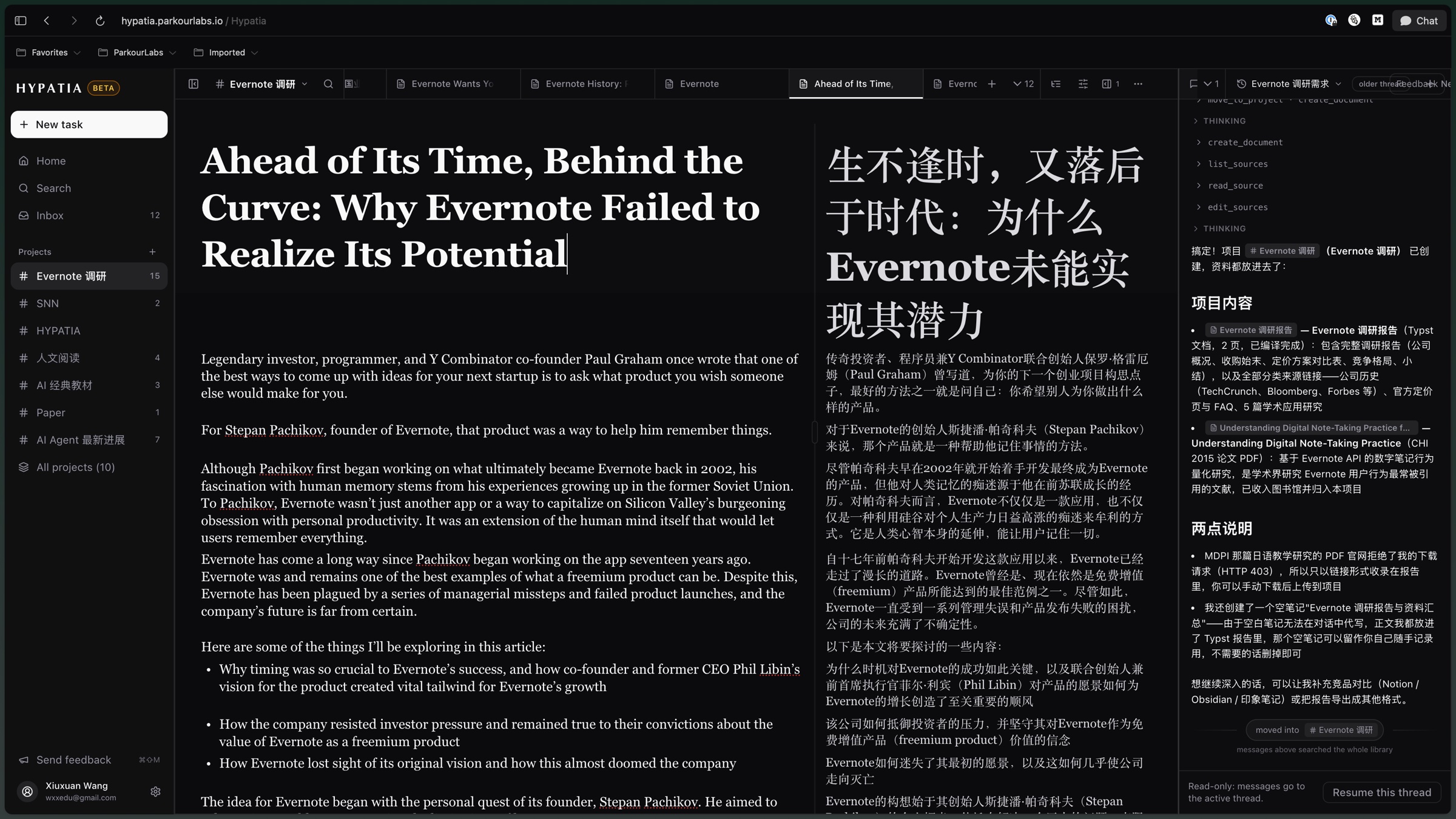
I read about Evernote’s staggering funding rounds, and how a small, lovely note-taking company that even sold backpacks and T-shirts was swept along step by step by venture capital, through layoffs and a change of CEO, until it was finally sold.
A small, lovely product, pushed into growing into something it was never meant to be.
Still stunned, I looked up at the clock. It was past ten.
I was shocked. It felt like a long time since I had sat at a computer and read like that.
When I read articles on my phone, I close them after a couple of swipes. When I have a question, I throw it at AI out of habit. Every so often I get a burst of ambition, download a pile of papers and textbooks, organise them neatly, and then never open them again.
So if I have to believe that making HYPATIA means something, I think it might be this:
Now that answers are always within reach, maybe we still need some time to sit quietly at a computer and read and think.
Now that a product takes a day on average to make, maybe we need some products that are willing to be built slowly and changed slowly. Persistence takes time to prove, but slowing down is something we can do right now.
The report I mentioned at the start says the age of too many apps has produced no new winners at all. After reading Evernote’s story, I find that less frightening: Evernote was a winner once, and it still couldn’t hold on to itself. HYPATIA probably won’t be a winner. Then it won’t be. I’ll build it slowly.
If you too have a pile of papers you downloaded, organised and never opened again, you’re welcome to try HYPATIA: https://note.parkourlabs.io/?ref=CBRCAXH7. It’s still rough, and I fix a little of it each morning. Tell me about any problems you run into or features you want. I’ll write them down and fix them bit by bit.
Next I’ll write a series on twenty years of personal knowledge management software, starting with Evernote. If you’d like to read it, follow along or subscribe to the blog’s RSS feed.